Private dining in Tokyo: private rooms, buyouts and chef's tables explained, and when to bring the chef to you
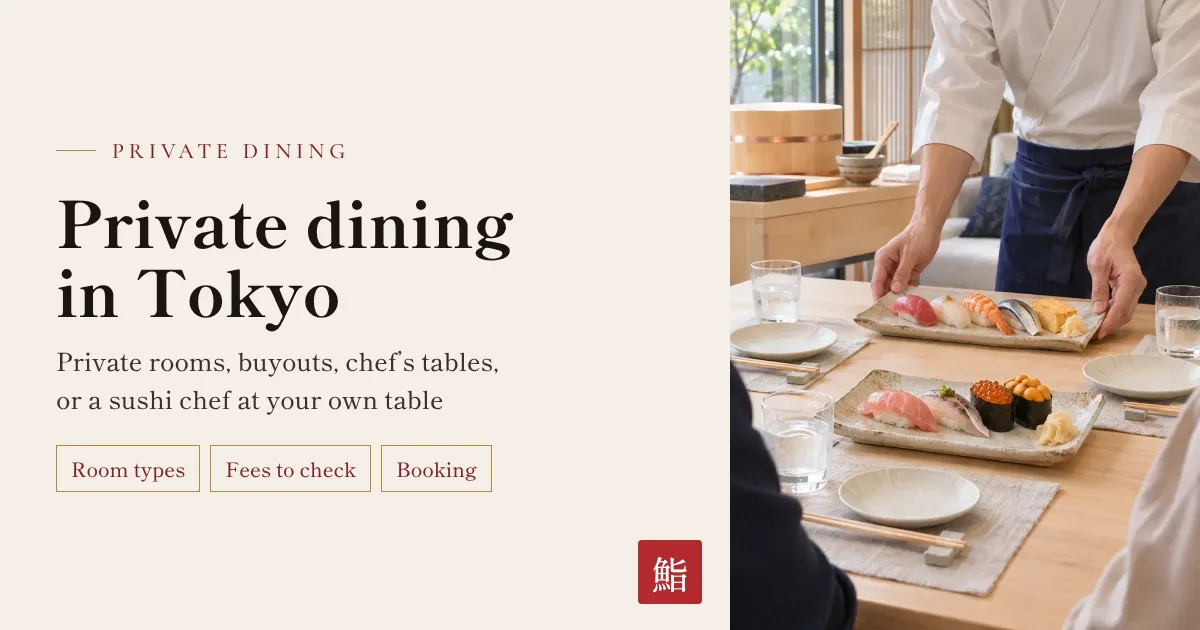
MEGUMI Sushi (東京出張寿司 MEGUMI鮨)
Key points
- "Private dining" in Tokyo can mean five different things: a private room at a restaurant, a hotel private dining room, buying out a small restaurant, a counter or chef's table for your group alone, or a chef who comes to your place.
- Japanese booking pages separate a fully enclosed room (完全個室) from a semi-private one (半個室). That one word decides how private your evening really is.
- The price on the list is rarely the whole story. Check the room charge, minimum spend or required course, service charge, time limit and cancellation terms before you confirm.
- If your group includes young children, many people, or guests who'd rather not go out again after a long day, having a chef come to your home, rental or office can be simpler than finding a room.
The short answer: Tokyo has plenty of private dining, but it comes in different forms, and the details that matter most are often written only in Japanese. Decide first which kind of privacy your group needs (a closed door, a whole restaurant, or your own space), then check the fees and rules that come with it. Lists of "best private dining restaurants" tell you where rooms exist. This guide covers what those lists usually leave out: how to read the room types, what the price may not include, what to ask, and when it's easier to have the chef come to you.
It's written for travelers, families and business visitors planning a dinner in Tokyo for a birthday, an anniversary, a team or a group of relatives. At the end, we explain the option we run ourselves: 東京の出張寿司 (a private sushi chef) from MEGUMI Sushi.
What counts as private dining in Tokyo?
When people search for private dining in Tokyo, they usually mean one of these five set-ups. Each has a different level of privacy and a different way of booking.
1. A private room at a restaurant (個室, koshitsu)
- What it is
- A separate room inside a restaurant. Very common at izakaya, yakiniku, kaiseki and some sushi restaurants.
- Good for
- Groups who want to talk freely, and families who want a little distance from other diners.
2. A hotel private dining room
- What it is
- A room in a hotel restaurant, usually with a set menu and English-speaking staff.
- Good for
- Business dinners and formal occasions where you want everything handled in English.
3. Buying out a restaurant (貸切, kashikiri)
- What it is
- Booking the whole restaurant for your group. Small places with one counter or a few tables sometimes accept this.
- Good for
- Parties that fill most of a small restaurant anyway, or events with speeches.
4. A counter or chef's table for your group
- What it is
- At small counters, your group takes all the seats for a sitting, or a restaurant has a separate table facing the kitchen.
- Good for
- Watching the chef work, as at an omakase sushi counter, without strangers beside you.
5. A chef who comes to your place
- What it is
- A private chef cooks or, in the case of sushi, makes each piece at your home, rental apartment, office or rented venue.
- Good for
- Families with small children, larger groups, and nights when nobody wants to travel across the city again.
Which Japanese words on booking pages matter?
Many restaurants describe their rooms only in Japanese, and automatic translation often turns them all into "private room." These are the words worth recognizing:
完全個室 (kanzen koshitsu)
- Meaning
- A fully enclosed private room, with walls and a door.
半個室 (han-koshitsu)
- Meaning
- Semi-private. Separated by a partition, curtain or screen, so you may still hear the next table.
座敷 (zashiki)
- Meaning
- A tatami room. You take your shoes off and sit on cushions on the floor. Lovely, but hard for some older guests.
掘りごたつ (horigotatsu)
- Meaning
- A low table over a sunken floor, so you sit on the floor with your legs down. Shoes usually come off here too.
テーブル席 / 椅子席
- Meaning
- Table seating with chairs.
貸切 (kashikiri)
- Meaning
- Exclusive use of the whole restaurant or floor.
個室料 (koshitsu-ryō)
- Meaning
- A room charge, added on top of food and drinks.
コース限定 / コースのみ
- Meaning
- "Course only." The room comes with a set menu, not ordering from the menu.
飲み放題 (nomihōdai)
- Meaning
- All-you-can-drink, usually for a fixed time.
税込 / 税抜
- Meaning
- Price including tax / excluding tax. Compare prices on the same basis.
If a page shows a photo of a room with a low table, check whether it's zashiki or horigotatsu before booking for grandparents or anyone who can't easily sit on the floor.
What should you check about the price?
A private room is rarely priced like a normal table. The conditions vary from place to place, so read the restaurant's own page or ask directly. These are the items that most often change the final bill:
- Room charge: a flat fee or a per-person fee for the room itself.
- Minimum spend or required course: some rooms are only available with a course, or with a minimum number of people or total spend.
- Service charge: a percentage added to the bill, common at hotel restaurants and some others. It isn't a tip, and tipping isn't a general custom in Japan.
- Tax: check whether the course price includes consumption tax (税込) or not (税抜).
- Drinks: usually separate unless an all-you-can-drink plan is included.
- Table charge: at izakaya, a small starter (お通し, otōshi) often appears on the bill per person even if you didn't order it.
- Time limit: many rooms are booked by the sitting. At izakaya, a limit of around two hours is common.
- Cancellation and headcount changes: group bookings often carry fees for late cancellation or for fewer people turning up.
- Payment method: cards are widely accepted in Tokyo, but not everywhere. Ask if you're relying on one card or need one bill for the company.
How do you book a private room from abroad?
For popular rooms, especially in December and around holidays, book early. The common routes:
The restaurant's own site or phone
The most direct way to ask about rooms. Some places only take bookings by phone in Japanese.
Booking platforms
Some restaurants list rooms as a seat type. Check that you actually chose "private room" and read the cancellation policy.
Your hotel concierge
Helpful when the restaurant only takes Japanese calls. Give them your conditions (room type, chairs, children, allergies) in writing.
A short request that covers the essentials gets clearer answers. For example:
"We are 8 people (2 children aged 4 and 7) visiting Tokyo. We'd like a fully enclosed private room with chairs (not tatami) on [date] at 18:30. One guest is allergic to shellfish. Is there a room charge or minimum spend, and what is the cancellation policy?"
What should you ask before you confirm?
Use this as a checklist. Getting answers in writing (email or message) helps if plans change.
- Room type: fully enclosed or semi-private? Chairs, zashiki or horigotatsu?
- Capacity: does the room fit your exact number comfortably, or will you be split across rooms?
- Menu: course only, or can you order freely? Can the course be adjusted?
- Allergies and diets: name the food clearly and ask whether they can adjust. Don't wait until the day.
- Children: are they welcome in the room? Is there a children's menu, high chair or space for a stroller?
- Access: stairs or a lift? Is the room on a floor reachable for older guests or a wheelchair?
- Time: what time must you leave the room?
- Costs: room charge, service charge, tax, minimum spend.
- Changes: by when can you change the number of guests, and what does a cancellation cost?
- Payment: card or cash, one bill or split, receipt with a company name.
What about large groups and children?
These are the two situations where private rooms most often fall short.
Large groups (10 or more): many private rooms seat around four to eight. Bigger groups may be split across neighboring rooms or offered a buyout, and the menu is usually fixed. If everyone should sit together and hear each other, ask specifically for one room for your exact number.
Children: a closed room helps, but small children still have to sit through a long course in a new place, often after a full day of sightseeing. Check the rules about children when you book, and plan the start time around naps and bedtime rather than the restaurant's busiest sitting.
Which option fits your group?
Business dinner with clients
- Often fits
- A hotel private dining room, or a fully enclosed room at a restaurant your guests will recognize.
Couple or small group who want to watch a chef
- Often fits
- A counter you book out for your group, or a chef's table.
Friends who want a lively evening
- Often fits
- An izakaya private room with a course and all-you-can-drink plan.
Family with young children or older relatives
- Often fits
- A room with chairs and step-free access, or a chef at your rental or home so nobody has to travel.
Team or company group
- Often fits
- A buyout, a large room, or a chef who comes to your office or a rented space.
What if the chef comes to you?
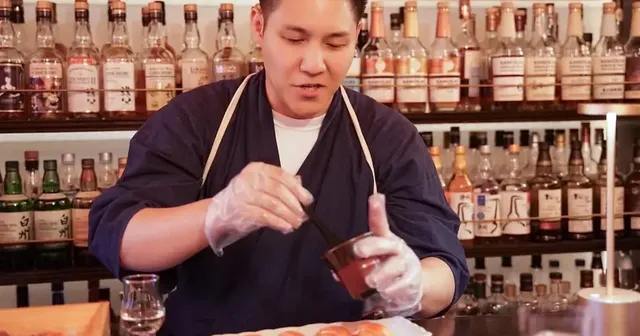
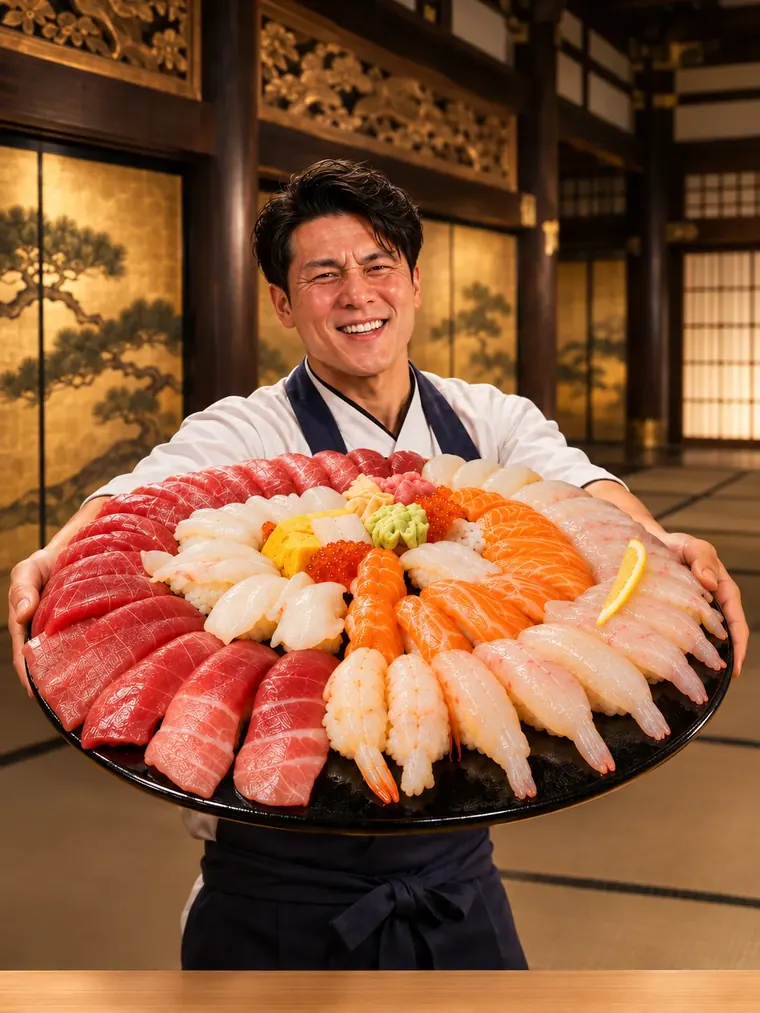
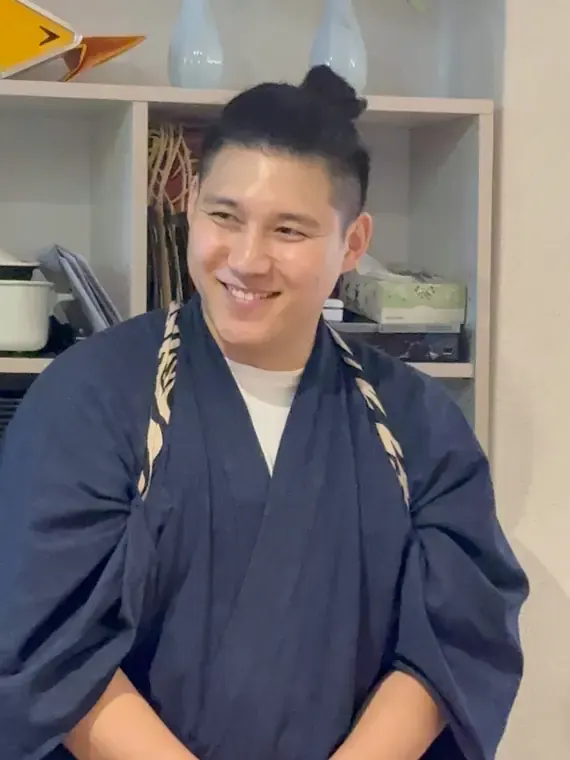
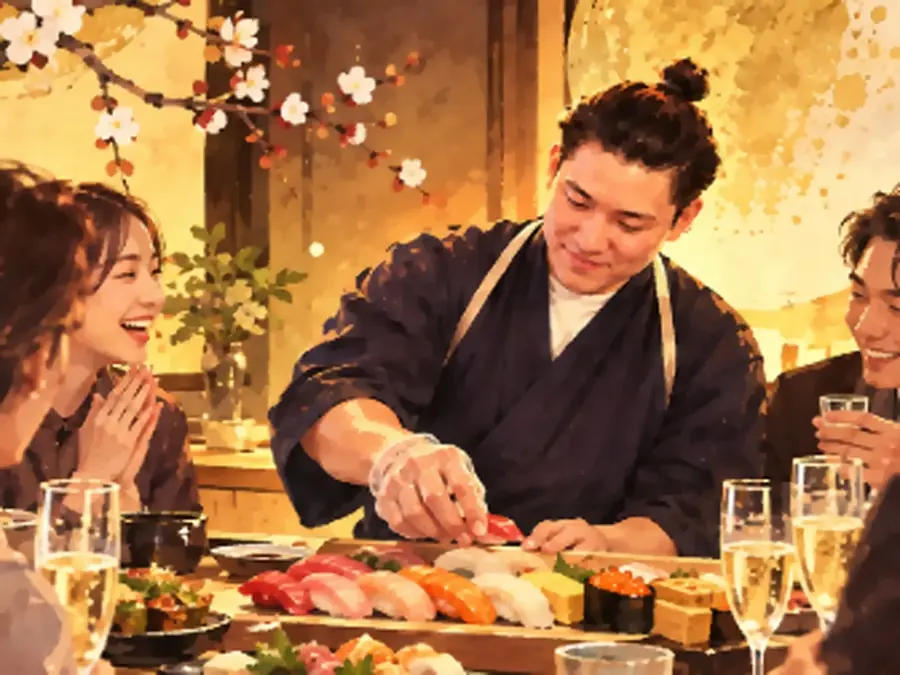
If your group already has a good space (a rental apartment, a home, an office or a rented party room), the most private room in Tokyo may be the one you're staying in. With MEGUMI Sushi, a sushi chef comes to your place in Tokyo's 23 wards and makes sushi in front of you, so the "chef's counter" is your own table.
Privacy
- Restaurant room
- Depends on the room type; other guests are in the building
- Chef at your place
- Only your group
Group size
- Restaurant room
- Limited by the room
- Chef at your place
- From 1 guest. For 10 guests or more, ask first so enough chefs can be arranged; groups of 100+ can also be discussed
What you get
- Restaurant room
- Depends on the course
- Chef at your place
- 10 chef's-choice pieces + ara-jiru (fish-bone soup) or akadashi (red miso soup) per guest
Price for visitors
- Restaurant room
- Course plus any room charge, service charge and drinks
- Chef at your place
- $100 per guest, all included (chef's visit, ingredients, transport within the 23 wards). Paid in cash, in Japanese yen, on the day, at that day's exchange rate
Time
- Restaurant room
- Often a set sitting
- Chef at your place
- About 1.5 hours from arrival to clean-up. The chef cleans up
Getting there
- Restaurant room
- Everyone travels to the restaurant
- Chef at your place
- Nobody goes out
What you set out: a table, running water, and drinks such as tea. The chef brings chopsticks, small and serving plates, soy sauce, wasabi and gari (pickled ginger). Other equipment is checked in advance, depending on the venue and group size.
Check your venue first: if you're using a hotel, a rented venue or a shared room in an apartment building, please check with the manager that an outside chef may prepare and serve food there.
Dietary needs: tell us about allergies, foods someone doesn't eat, or vegan, vegetarian or religious diets before booking. We'll check the details and tell you whether we can adjust the menu.
Extras: extra nigiri and some drinks can be arranged for an additional charge, explained in advance. Flowers, gifts and decorations are not included.
New to eating at a sushi counter? Our guide to sushi etiquette in Japan covers chopsticks, soy sauce and what isn't actually rude.
How do you ask MEGUMI Sushi?
- To ask first: add our official LINE account and send the date, number of guests, area and occasion. A rough idea is fine. Asking does not confirm a booking.
- To book now: pick an open slot on the booking calendar (Japanese). Please write "Overseas guest" in the ご要望 (requests) box so we apply the $100 price.
- Start times: weekdays from 19:30 to 21:30, and weekends and holidays from 12:00 to 19:00.
- Language: LINE and the booking pages are in Japanese. You're welcome to write in English: say so in your first message and ask about language support for the day.
Example message: "Hello. We are 7 people visiting Tokyo, including 2 children. Could you come to our apartment in Minato-ku on [date] around 19:30 for a family dinner? One of us does not eat shellfish."
Planning from abroad? Read how to have a sushi chef come to your home, rental or office in Tokyo. Prices and booking are on the MEGUMI Sushi English page, and the original Japanese details are on our 東京の出張寿司 page.
Private dining at your own table in Tokyo
MEGUMI Sushi's chef comes to you and makes sushi in front of you.
- $100 per guest, all included (chef, ingredients and transport)
- Each guest: 10 chef's-choice pieces + soup
- Pay in cash, in Japanese yen, on the day
- Please provide a table, running water and drinks. Tokyo 23 wards (ask about other areas)